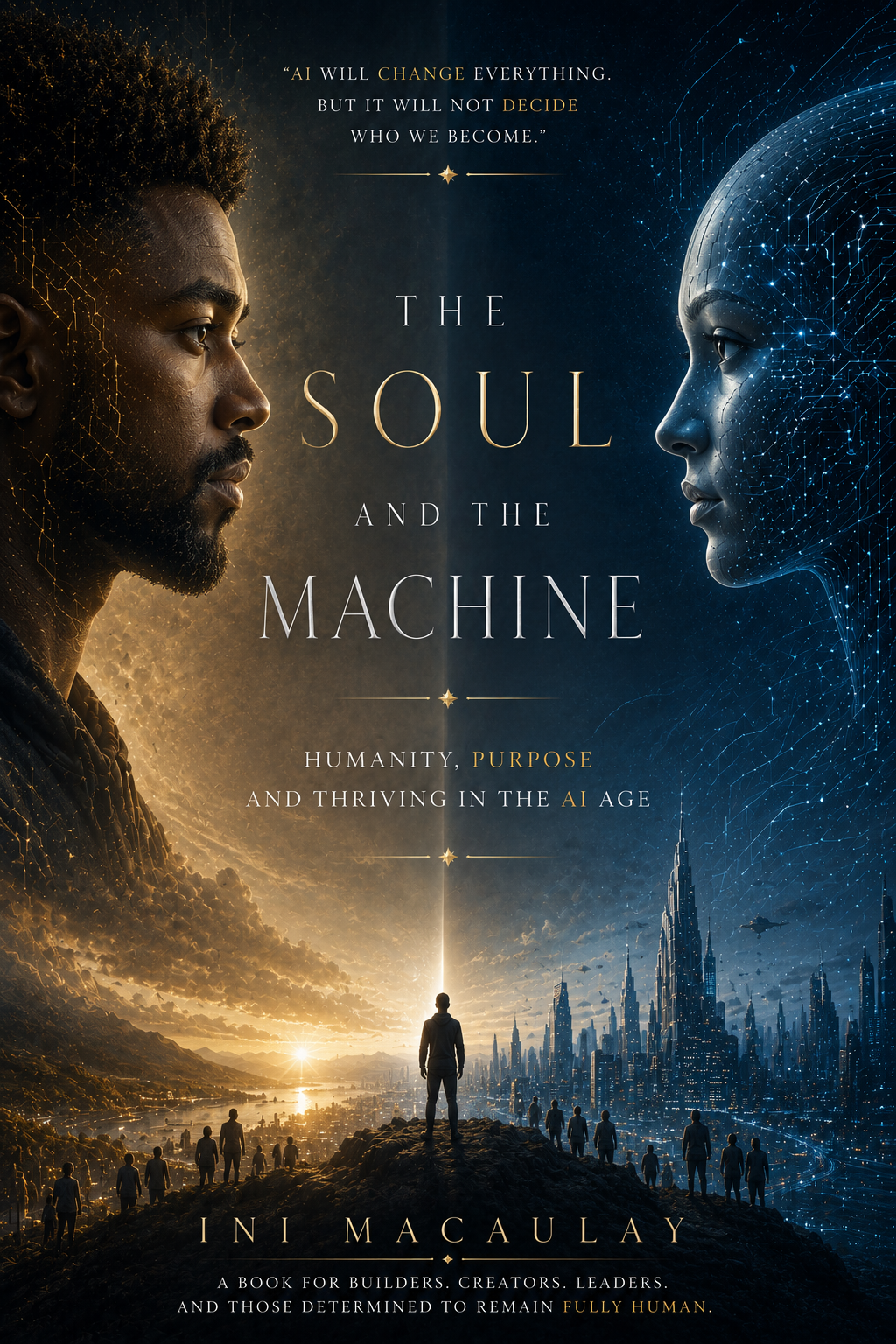
Contents
A few years ago I watched a manager I respect make a call in nine seconds that a model could have made in nine milliseconds, and made better. He got it wrong; the machine would have got it right. And yet every person in that room would have followed him off a cliff, and not one of them would follow the model across the street. I have not stopped thinking about that gap. It is exactly where leadership now lives.
The Leadership Error Most People Are Making
The dominant conversation in business leadership right now is about AI adoption: how to implement AI tools, how to build AI teams, how to develop AI strategy.
This conversation is important. But it is the secondary conversation.
The primary conversation, the one most leadership development misses, is about the human qualities that AI cannot replicate and that are therefore becoming more valuable, not less.
In a world where machines can analyse, synthesise, generate, and optimise at scale, the scarce resource is not analytical capacity. It is human judgment. Moral courage. Earned trust. The ability to hold a room, to see the person behind the spreadsheet, to make a decision in the presence of irreducible uncertainty and live with the consequences.
These are not soft skills. They are, increasingly, the hardest skills in the room.
Three Capacities No Machine Can Carry for You
1. The capacity to hold presence
Presence is the ability to be fully in a conversation, not thinking about the next meeting, not mentally drafting your response while someone is still speaking, not half-attending because your phone is on the table.
This sounds simple. In practice, it is rare. And it is becoming rarer, because every technology we use is designed to fragment attention.
Leaders who can be fully present with people, who make them feel genuinely seen and heard, have a quality that no AI can replicate. People will not follow systems. They will follow people who see them.
2. The capacity to make meaning
When a team is disoriented, when the future is uncertain, when the change is hard, when the numbers do not tell the whole story, they look to their leader not for data but for narrative. For an account of where we are, why it matters, and what it calls for.
AI can generate explanations. It cannot make them mean something. Meaning requires a person who has skin in the game, who has their own history with the work, who is themselves on a journey that the people around them can see.
The leader who can make meaning, who can say "this is why we are here, and this is why it matters", is providing something irreplaceable.
3. The capacity for moral courage
The AI age is generating ethical questions faster than organisations are building ethical frameworks. Questions about data, about privacy, about automation, about who benefits and who bears the cost, about what values should and should not be encoded in systems that shape millions of lives.
These questions require leaders with the capacity for moral courage: the willingness to take positions, to name what is wrong even when it is inconvenient, to refuse easy compromise with things that matter.
Moral courage cannot be optimised for. It is grown, through character, conviction, and practice.
The Leader Africa Needs
I write specifically about African leadership because it is the leadership context I know best, and because I believe it is underrepresented in global conversations that have direct relevance to it.
The African professional navigating the AI age faces specific pressures: the pressure to adopt tools designed for other markets, in other languages, for other contexts. The pressure to compete globally while building locally. The pressure to move at tech speed while serving communities that have different rhythms and needs.
The leader Africa needs is not a smaller version of a Silicon Valley archetype. It is someone who has integrated world-class technical and strategic capability with a deep rootedness in African identity, values, and relational intelligence.
This integration, not imitation, is the source of the distinct contribution African leaders can make to the global AI age.
What This Means for Your Development
If you are developing as a leader in this moment, I would encourage you to ask three questions:
What is the quality of my attention when I am with people? Not when I am performing attention, when I genuinely offer it?
Am I developing the capacity to make meaning, to articulate what matters and why, in ways that resonate with different kinds of people?
Do I have convictions I would be willing to lose something for? Or are my "values" simply preferences I hold when holding them is comfortable?
These questions do not have quick answers. They are the work of years. But they are the work that produces the kind of leadership that endures.