Contents
Every transformative technology reshapes not just what we do but who we are. The printing press did not just spread information, it changed how people thought about authority, about knowledge, about their own capacity to understand the world. AI is doing the same thing, faster, and to more people simultaneously.
A Relationship, Not a Tool
The most useful frame I have found for understanding artificial intelligence is not technological. It is relational.
We are in a relationship with AI, a relationship that is shaping us even as we shape it. Like any significant relationship, it reveals our character under pressure. It exposes our insecurities. It tests our values. It offers extraordinary gifts and, if mishandled, creates profound dependencies.
The question is not whether to have this relationship. That choice has been made for us, collectively. The question is what kind of relationship it will be: one that makes us more human, or one that slowly makes us less so.
What AI Is Doing to Human Thinking
I am not a pessimist about AI. I am a realist, which means I try to see both what is being gained and what is being lost in the transaction.
What is being gained is genuine. AI gives access to knowledge, analysis, and creative assistance that was previously available only to the privileged. A student in Lagos can now access the equivalent of a world-class research assistant. An entrepreneur in Nairobi can produce professional-grade work without a large team. A parent anywhere can get clear medical information without a medical degree.
This is real, and it matters.
What is being lost is also real, and it also matters.
When we outsource thinking consistently, we lose the capacity to think. This is not metaphor, it is neuroscience. Cognitive capacities atrophy without use. When we let AI do our writing, our research, our reasoning, our planning, we are not just saving time. We are slowly uninstalling software that took years to build.
The question of what to outsource and what to keep, and why, is one of the most important personal and professional decisions of our era. Most people are making it by accident.
The Three Failure Modes
In my observation, most people fall into one of three failure modes in their relationship with AI.
The Avoider treats AI as threat or temptation and minimises engagement. This feels principled but is practically self-defeating. The Avoider is not protecting their humanity, they are disqualifying themselves from a conversation that is happening with or without them.
The Surrenderer uses AI for everything without discrimination. This feels productive but is actually a form of learned helplessness. The Surrenderer is not augmenting their capability, they are outsourcing their agency.
The Unreflective Adopter uses AI tools because they are useful without asking deeper questions about what kind of person those tools are making them. This is the most common and, in some ways, the most dangerous mode, because it feels fine.
The posture I believe matters is something different: intentional integration. Using AI as a collaborator in full awareness of what you are bringing, what it is bringing, and what the collaboration should and should not include.
The African Dimension
I write from Port Harcourt, and I cannot think about AI without thinking about Africa.
The AI age arrives in Africa with a particular set of tensions. On one hand, it arrives as accelerant, giving African builders, thinkers, and creators access to capabilities that were previously locked behind wealth and geography. On the other hand, it arrives as another tide of technology shaped by other people's assumptions, trained on other people's data, reflecting other people's values.
The question for African professionals is not just "how do we adopt AI?" It is "how do we shape it, and how do we ensure that in adopting it, we do not lose what is distinctly ours?"
That second question requires clarity about what "distinctly ours" means. It requires a settled sense of identity, knowing who you are and what you value, before you decide which tools to use and how to use them.
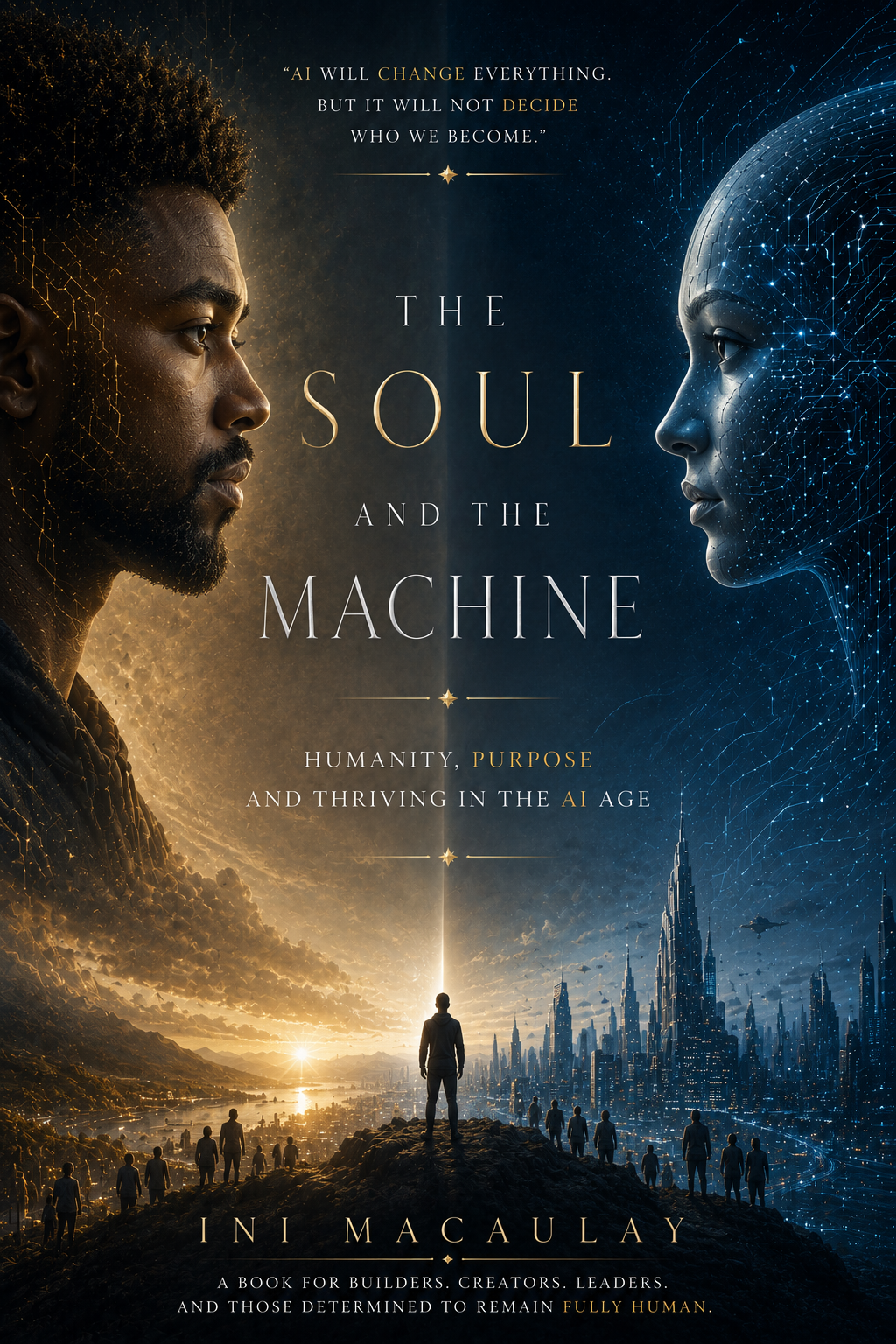
This is one of the reasons I wrote The Soul and the Machine from where I am, not from a sanitised global perspective. The particularities matter. The place matters. The tradition matters.
What Good Integration Looks Like
The people I have seen navigate the AI age well share a common characteristic: they know what they are for.
They have a clear sense of their purpose, their craft, their values, and the specific contribution they want to make. This clarity tells them what to automate and what to protect, what to amplify and what to slow down, what to trust the machine with and what to keep entirely to themselves.
Without that clarity, every AI tool is both a gift and a trap. With it, the same tools become instruments of genuine flourishing.
Clarity of purpose is not a productivity hack. It is a prerequisite for being human in the AI age.