Contents
Most conversations about AI start in the wrong place. They start with the machine. The better place to start is with the question the machine is forcing us to answer about ourselves.
The Confusion at the Centre of Every AI Conversation
There is a word that appeared in almost every conversation I had in the year I spent writing about artificial intelligence and the human soul. The word was not "ChatGPT." It was not "neural network" or "large language model." The word was "it."
"It can write essays." "It passed the bar exam." "It will take your job." "It might become conscious."
This small word, it, carries an enormous amount of hidden weight. It implies a unified, coherent thing with intentions, capacities, and perhaps a trajectory toward something. It makes AI sound like a person who has not yet fully arrived.
I want to slow down here, because I believe the confusion about what AI is, at the most basic level, is producing bad decisions, bad fear, and missed opportunities in equal measure.
What AI Actually Is
Artificial intelligence, in its current dominant form, is a pattern-matching system trained on human-produced text and data.
That is a deliberately flat description, and I use it deliberately. Not to dismiss AI, its capabilities are extraordinary, but to locate it accurately.
When a large language model like GPT-4 or Claude responds to your question, it is doing something genuinely remarkable: it is predicting, based on billions of patterns learned from human writing, what text should come next. It is doing this at a scale and speed no human can match, and the outputs are often startlingly good.
But it is not thinking. It is not understanding. It is not experiencing. It has no goals, no desires, no fear of death, no experience of Tuesday morning, no memory of a conversation it had yesterday.
This is not a minor technical detail. It is the most important thing to understand about the technology reshaping our world.
The Confusion Has Consequences
When we mistake pattern-matching for understanding, we make two opposite errors simultaneously.
We overestimate AI in ways that matter. We trust it with decisions that require genuine judgment, medical, legal, moral. We allow its confident outputs to substitute for our own thinking. We treat its fluency as evidence of its wisdom.
We underestimate AI in ways that matter. We dismiss concerns about its impact because "it's just predicting the next word." We underinvest in understanding it because we assume it's too complex. We fail to develop the human capacities that AI genuinely cannot replicate.
Both errors come from the same source: not knowing what we are actually dealing with.
What It Cannot Be
There are things AI cannot be, not because of current technical limitations, but because of what it is.
It cannot be curious in the way you are curious. Curiosity is born of lack, of the felt experience of not knowing something you want to know. AI does not experience lack. It does not want.
It cannot be courageous. Courage requires something to lose. AI has no stakes. When it gives you an answer that might be wrong, it is not being brave.
It cannot love. Love is not a pattern extracted from millions of love letters. It is the particular, unrepeatable, vulnerable attention of one specific person to another specific person.
It cannot mean. Meaning is not produced by text. It is produced by lives, lived, suffered, chosen, remembered.
This is not a defence of human exceptionalism for its own sake. It is a map. It tells you what you still own, even as machines take on more of what you used to do.
The Right Question
The wrong question, as I have come to see it, is: "What can AI do?"
The right question is: "What does AI's existence reveal about what only we can do?"
That second question has a long answer, an answer worth spending a lifetime exploring. This Knowledge Centre is one attempt to begin that exploration.
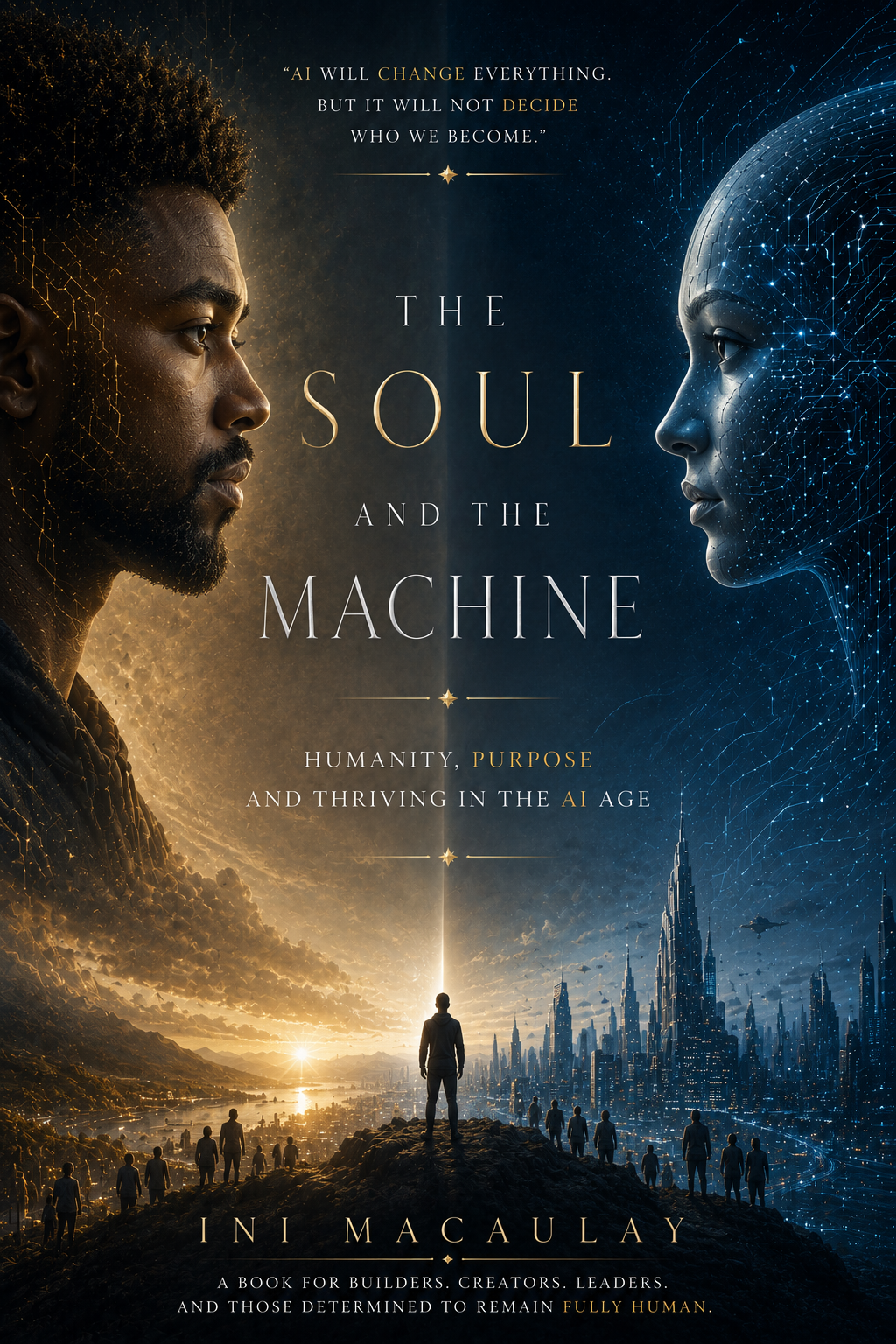
If you want to go deeper, the place I return to most is the thinking I developed in writing The Soul and the Machine, a book written in the belief that the people who will thrive in the AI age are not those who understand the machine best, but those who understand themselves best.