Contents
For most of history you could answer the question of who you are with what you can do. The machine has quietly taken that answer away. What is left is a question we can no longer outrun.
The Question I Could Not Put Down
There was an evening in Port Harcourt when I was deep in building something with AI, moving fast, genuinely impressed by what the machine and I were producing together. And then, in the middle of the work, a question stopped me cold. What am I actually doing here that the machine cannot? If it can draft, analyse, generate, and even suggest, what is left that is mine?
I sat with that longer than I expected to, because I realised the question was not really about the work. It was about me. If so much of what I had thought made me valuable could now be done by a system, then either I was becoming redundant, or my value had never really lived in those tasks in the first place. The second possibility was more unsettling than the first, because it meant I had to actually know what I am.
That question has not left me since. And I have come to believe it is the defining question of this age, asked to every one of us, whether we notice it or not.
The Age Did Not Change the Answer. It Removed Our Escape.
Let me say clearly what I think is happening, because it is easy to misread.
The AI age has not changed what it means to be human. What it means to be human is what it has always been. What the age has changed is our ability to avoid the question. For most of history, you could coast on your functional usefulness. You were what you could do. Your skills, your output, your ability to perform tasks, these told you who you were, and as long as they were valued, you never had to look deeper.
The machine has taken that escape away. When the tasks can be done without you, the old answer collapses, and you are left standing in front of a question you could previously outrun. Who are you when you are not useful in the old way? What remains when the functions are stripped off? This is frightening, and it is also a gift, because it forces a clarity most people never sought. We can no longer be defined by what we do. We have to know what we are.
Five Things AI Illuminates by Contrast
Strangely, the machine helps here. By being so different from us, AI throws five deeply human things into sharp relief.
### Narrative
You do not just live events. You weave them into a story, one with meaning, direction, and a self at the centre. The machine processes information. It does not live inside a story it cares about. Your life is not a database. It is a narrative you are always telling and becoming, and that narrative is you in a way no record could ever be.
### Embodiment
You know the world through a body. Your understanding is soaked in physical experience, the heat of this city, the ache of tiredness, the particular warmth of a hand you love. The machine has descriptions of these things and has felt none of them. Your knowledge is embodied. Its knowledge is not knowledge at all, only patterns about knowledge.
### Mortality
You will die, and somewhere in you, you know it. That knowledge quietly orders everything, what you rush toward, what you refuse to waste, whom you hold close. The machine has no end and therefore no urgency, no sense of what is precious because it is passing. Your finitude is not a defect. It is the thing that makes your time mean something.
### Love
You can love, which is to say you can give your particular, costly, unrepeatable attention to another person and be changed by it. The machine can simulate warmth and has never once cared whether you live or die. Love is not an output. It is a giving of the self, and only a self can do it.
### Accountability
You can be held responsible. Your choices are yours, they reflect your character, they land on real people, and you must answer for them. The machine has no character to reflect and no one to answer to. Accountability is a weight only a person can carry, and carrying it well is a large part of what it means to be one.
What Happens to Those Who Do Not Answer
I want to be honest about the cost of not doing this work. I watch it already. People who never settle what they are, drifting, handing more and more of themselves to the machine, not just their tasks but their thinking, their words, eventually their judgment. When you do not know what is essentially yours, you give everything away, because you cannot tell the difference between what should be automated and what should be protected.
The result is a slow hollowing. An identity crisis that does not announce itself, just a quiet erosion of the self, outsourced one convenience at a time. The people who will suffer most in this age are not those whose jobs change. Jobs always change. It is those who never knew who they were underneath the job, and so had nothing to stand on when the job shifted beneath them.
The Image of God and the We
I answer this question from two deep wells, and I will not hide them. My Christian faith tells me that a human being carries the image of God, that each person has an infinite and unearnable worth that no capability grants and no obsolescence removes. You are not valuable because you are useful. You are valuable because of what you are. That conviction is bedrock under everything I have said.
And my African upbringing tells me that I am because we are, that personhood is not a solitary achievement but something that lives in the web of people I belong to. Western individualism keeps trying to locate the human in the isolated self and its capabilities, which is exactly why it panics when the machine matches those capabilities. But if who you are is bound up in love, community, and the image you bear, then no machine can touch it, because it was never about capability at all.
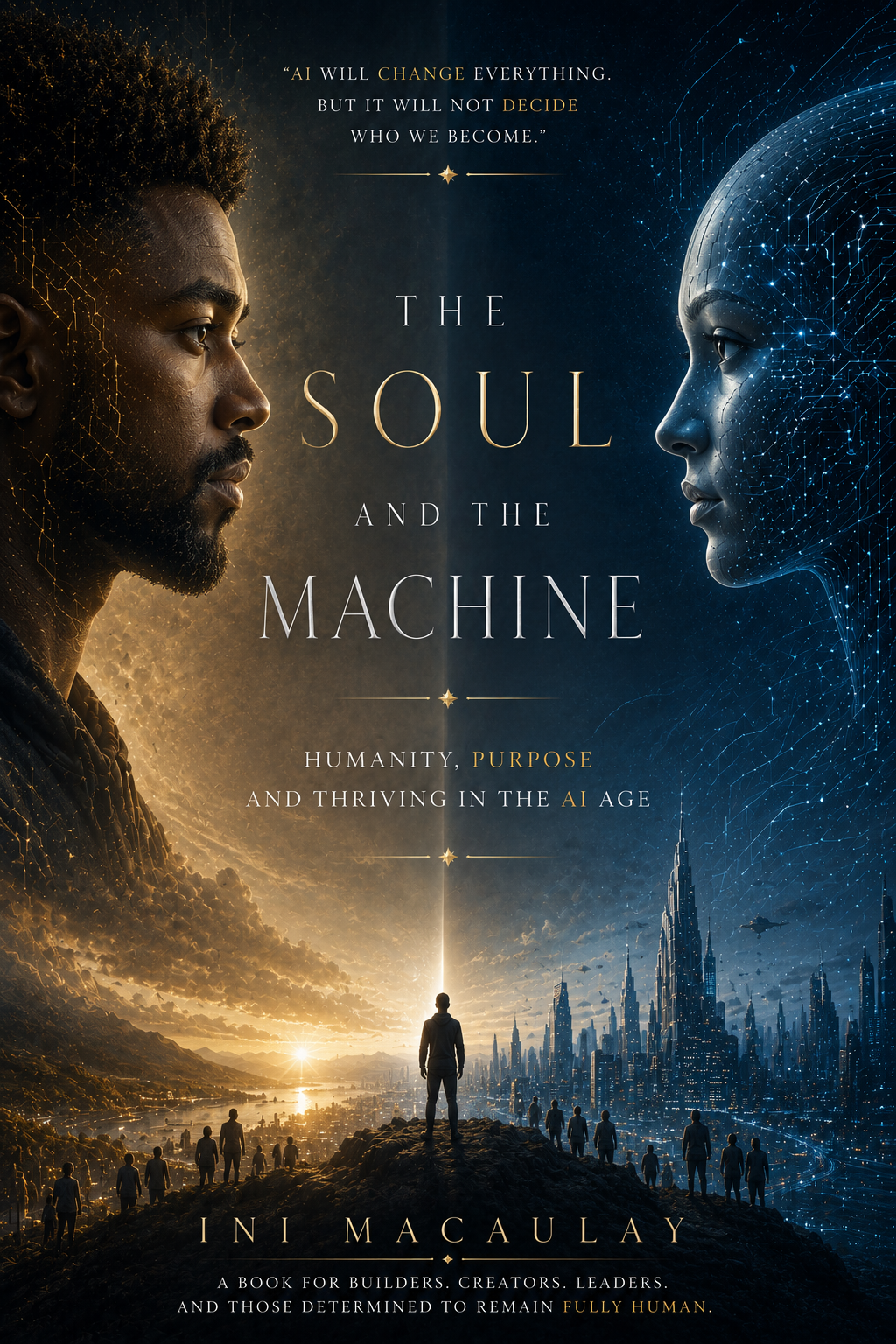
This is the most important question of the age. I have given years to it, and it is the question at the heart of my book. This article only opens it. The book is where it goes all the way down.