Contents
Soul is a word many thoughtful people quietly retired, embarrassed by how unscientific it sounds. And yet no one manages to live without it. We grieve as though a person has gone, not a set of processes. I want to recover the word, because the age of algorithms is exactly the age that cannot do without it.
The Word We Almost Stopped Using
Soul is a word many educated people quietly retired. It sounds unscientific, a relic from before we knew about neurons. And yet no one actually lives as though they lack one. We grieve as if a person, not a set of processes, has gone. We fall in love with someone, not with their data. The word we abandoned in theory, we cannot stop using in practice, because it names something we all know is there.
I want to recover it, carefully, because the age of algorithms is precisely the age that most needs it. When systems can predict what you will click, curate what you will see, and increasingly imitate how you think, the question of whether there is a you underneath all that, a you that is more than the sum of your behaviour, stops being academic. It becomes the ground you have to stand on.
What Faith Means by the Soul
In the Scriptures the soul is not a wispy thing trapped inside a body, waiting to escape. The Hebrew imagination speaks of the whole living person, breathing, desiring, willing, in relationship with God. The soul is you, considered as a living being who came from God and answers to God. It is the seat of your loves, your will, your worship. It is what makes you a someone and not a something.
Two convictions follow, and both matter here. First, the soul is not earned or achieved. It is given. You do not perform your way into having one. Second, the soul is made for God. Its deepest orientation is toward the One who breathed it into being, and it is restless, in the old and true phrase, until it rests there.
That is a very different account of a person than the one the age of algorithms assumes. The systems see a bundle of behaviours to be predicted. Faith sees a living soul, given by God, addressed by God, answerable to God, and never fully captured by any measurement of what it did yesterday.
Why the Soul Cannot Be Reduced to Data
An algorithm knows you by your traces. What you watched, how long you paused, what you bought, where you lingered. From those traces it builds a model, and the model can be uncannily accurate. It can predict your next move better, sometimes, than you can.
But accuracy is not identity, and this is the point everything turns on. A model of your behaviour is not the being who behaves. It is a map, and the map is never the territory. The proof is that you can break the model. You can do the thing you have never done, forgive where you always resented, stay where you always fled, love against the grain of your own history. A soul can repent, which means a soul can become what no extrapolation of its past would predict. The system can describe the ruts you have worn. It cannot see the freedom that could climb out of them.
So when a profile claims to have captured you, faith answers that it has captured a shadow. The real you is the one casting it, the living soul that exceeds every dataset because it was made by God and not by its own record.
Formed by Systems That Do Not Love Us
Here is what should sober us. The soul is always being formed. It is never static. Your loves are trained, your attention is shaped, your sense of yourself is built up, day by day, by whatever you give yourself to. The old teachers knew this. They called it formation, and they took enormous care over what does the forming.
Much of that forming has now been handed, quietly, to systems that were not built to love us. They were built to hold us. An engine tuned to maximise engagement is, whether it intends to or not, discipling its users. It is teaching us to want the next thing, to tolerate less silence, to measure ourselves by response. This is spiritual formation running in the background, with no soul in view and no love behind it, aimed at a metric rather than at our good.
To name this is not paranoia. It is the ordinary Christian awareness that we become what we behold, and that we had better be deliberate about what we behold, because something is always shaping us and it will not ask permission.
The Discipline of Resistance
If systems are forming the soul without loving it, then the faithful response is counter-formation, the old disciplines taken up on purpose against the current.
Silence, so the noise does not become the whole of your inner life. Sabbath, a regular refusal to be endlessly available and productive, which tells the machine and your own anxious heart that your worth is not your output. Scripture read slowly, forming your mind by a word that is not engineered to keep you scrolling. Prayer, which is the soul turning toward the God who made it. Real presence with real people, which no feed can counterfeit.
None of this is dramatic, and that is exactly its power. Formation happens in small, repeated acts, which is how the systems form us and how the soul is reclaimed. You resist algorithmic formation not by grand gestures but by quietly, daily choosing the long and the slow and the true over the fast and the frictionless.
An Identity No System Can Model
In the end, faith gives the soul something no algorithm can assign and none can revoke. An identity that is received rather than performed.
Every system that touches your attention is also, subtly, ranking you. More or less popular, more or less engaging, more or less worthy of the next unit of attention. Live inside that long enough and the soul begins to believe it is only as valuable as its latest score.
Faith cuts the root of that lie. It says you are already known, already named, already loved, before you produce anything and independent of how you perform. That identity was settled by God, not by the feed, and the feed has no authority to change it. This is the deepest freedom available to a person in the age of algorithms. Not to be measured well, but to be so securely held that the measuring loses its power over you.
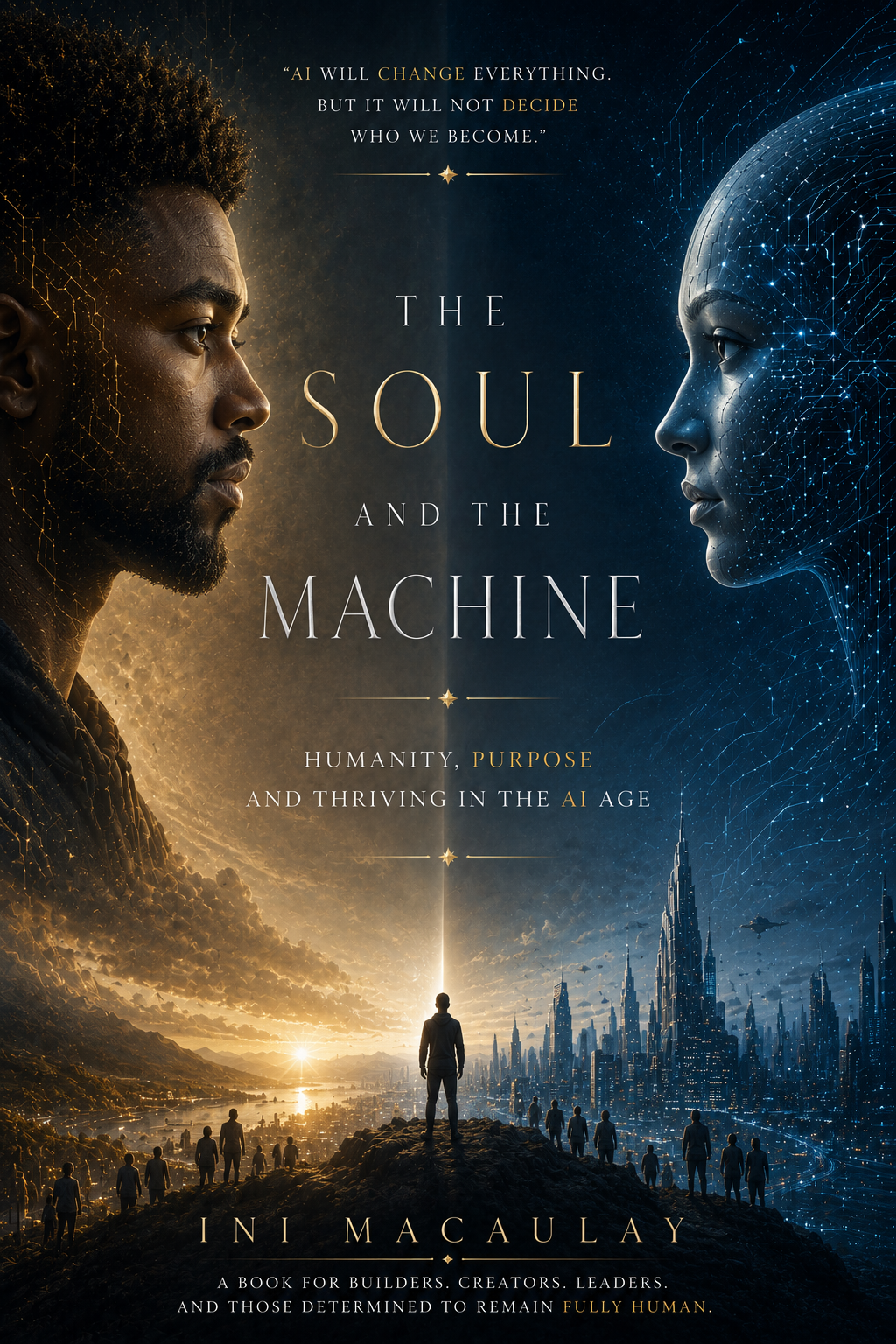
That is the territory The Soul and the Machine was written to explore, and it is the ground I keep returning to from Port Harcourt. The machines can model the shadow endlessly. The soul, the living self given and held by God, stands just outside their reach, and learning to live from there, rather than from the profile, is the whole of the task.